.
Yesterday I had the opportunity to listen to my friend Professor Francesc de Carreras , because of the teaching conference held at the ICAB, under the title: "After the decision:" the statute is constitutional or unconstitutional? "
I transcribe here the chronicle by The Voz de Barcelona .
Francesc de Carreras says that the decision of TC was "foreseeable" and that politicians only heard of lawyers who told them what they wanted to hear.
"The Constitutional Court ruling leaves well enough alone." The "statement" is referring to the Statute of Autonomy of Catalonia of 2006 and the "way things were" is the Statute of Autonomy of 1979. These words of Professor of Constitutional Law at the University Barcelona (UAB) Francesc de Carreras, after a detailed analysis of the decision of the High Court, said "has been a journey for nothing."
 En este sentido, De Carreras recordó que el TC, siendo “el último intérprete de la Constitución”, ha “alterado el sentido del Estatuto” y las “finalidades que pretendía”. Pese a que no es un sentencia extensa and only recognizes 14 items zero, the High Court does state "doctrine in the legal bases" for almost a hundred more items. Something that, for the professor of Constitutional Law, was "foreseeable" because "most of the arguments are based on earlier rulings" and did not appear to be a decision "groundbreaking." So, this was known when the statutory text adopted by the Parliament of Catalonia? Yes

degree project, on Thursday at the Bar Association of Barcelona (ICAB), a comprehensive and illustrative summary of the consequences, both legal and political, of the Constitutional Court (TC) on the Statute. Citing point by point, issue by issue, alterations to the text of the TC approved in 2006, namely: the term nation, the Catalan people, historical rights as the Constitution of Catalonia Statute, Statutory Rights Council, Síndic de Greuges, régimen local, Poder Judicial, régimen lingüístico y competencias, el especialista en la materia concluyó que “de todos los objetivos de los nacionalistas, no se ha conseguido ninguno”.
Políticos mal aconsejados
 En este sentido, De Carreras recordó que el TC, siendo “el último intérprete de la Constitución”, ha “alterado el sentido del Estatuto” y las “finalidades que pretendía”. Pese a que no es un sentencia extensa and only recognizes 14 items zero, the High Court does state "doctrine in the legal bases" for almost a hundred more items. Something that, for the professor of Constitutional Law, was "foreseeable" because "most of the arguments are based on earlier rulings" and did not appear to be a decision "groundbreaking." So, this was known when the statutory text adopted by the Parliament of Catalonia? Yes
 "Politicians have been ill-advised" and "between politicians and lawyers" there was a collusion that was fed. Is the origin? The study by the Institute of Catalan Studies (IEC) arguing away from legal reality, the steps and the direction to follow in the reform of the Statute of Autonomy of 1979. Politicians, Race said, "just called to consultations with the lawyers who said they wanted to hear." What the report said the IEC? That modifying the autonomy statutes modifying the model of the CCAA, ie modifying a status-of-state Law amended the Constitution, and the letter of 1978 in 2006 could be interpreted differently.
However, as noted by Professor of Constitutional Law, neither the report nor the politicians who embarked on statutory reform were considered, or would not take this into account, that the TC has created case law from 1978, besides the laws that Parliament has been approved since then, and that while this law may change, and indeed change, "it is foolish to think they can change so many things in one sentence."
Therefore, the decision of the High Court, the best guarantor of constitutional issues, he reminded the beadle of Autonomous status, both deputies, senators and congressmen and the statutes are organic laws but "not nearly a Constitution," which are categories-constitutional powers, can not be defined in the statutes of autonomy, that the statutes can not " content violating laws that are not regulated by statute "that is, national laws can not limit-and that, among other things, the right to autonomy" is limited to what determines the Constitution. "
"Instability democratic
De Carreras, before an audience of over fifty experts in the field, among whom was the deputy autonomic Citizens, Carmen Rivera , and the secretary general of the party, Matías Alonso -, they pointed out two important points that, after the ruling. One, referred to the "big hurt" in this process. The Constitutional Tribunal. From the viewpoint of a professor at the UAB, the TC has left untouched by the harassment of politicians and media to its function (task, on the other hand, has been delayed more than other sentences). And another aspect he considers to be taken into account, the "instability" democratic public authorities, especially in Catalonia autonomous, they can create.
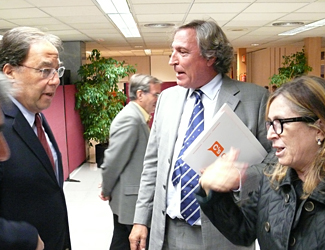
In this sense, De Carreras expressly referred to the language regime, noting that the Parliament of Catalonia "should correct or change the rules that are contrary the sentence "and have been approved. Career autonomic Members requested to act with "loyalty" to the law, because he recalled, "the TC judgments are binding for everyone but especially to the government. "
Finally, he proposed a constitutional reform, with the logical understanding between PSOE and PP, "which prevents statutes as intended from Catalonia", stabilize the state of autonomous and reform in the Senate. And in relation to the recent economic agreement CiU defendant facing the 28N, De Carreras, who warned that a quota system by the need not necessarily be unfair, "said it was not possible to Catalonia because it is based" under the law Navarre, attributable only to the three provinces the Basque Country and Navarra. It is, in the words of Professor of Constitutional Law, another way of CiU to create "victims" because it proposes Artur Mas "knowing that it is impossible."


0 comments:
Post a Comment